
IKEA Effect: Why Letting Clients “Help” Makes Your Work Stick
Your clients don’t just want perfect work - they want work they have an emotional stake in. That’s the IKEA Effect, and it might be the stickiest growth hack you’re not using. Your weekend brain fuel:

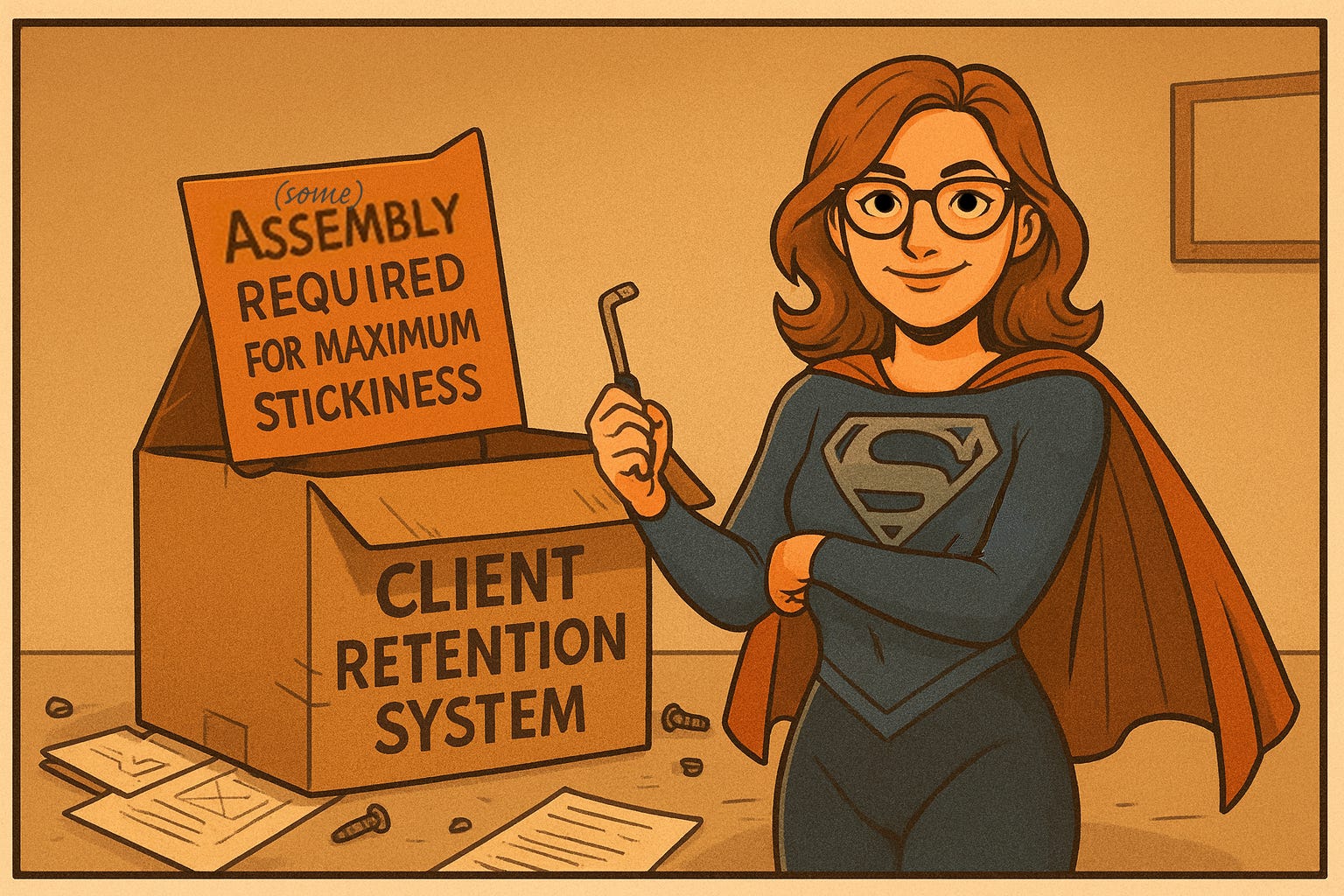
If you run an AI automation agency, a marketing shop, or really any kind of professional service business, you’ll eventually hit a milestone you’ll (rightfully) be very proud of but that could prove to be a bit of an obstacle to client satisfaction, retention and success :
You’ve done enough projects that you could take a client’s mess, disappear into your workflow cave, and return with a polished system, ad campaign, or funnel. With some very few particulars from the client, you can go Monk Mode and just do your thing. Especially for the solo-preneurial types who’d rather stare at three monitors than sit through three meetings, or super efficient teams, it actually makes more sense to do it that way.
You’re Clean. Efficient. Perfect.
And then…you lose your client. They quit on you or want some nonsense change they don’t actually need, or move to a competitor. Either way, that client somehow, inexplicably, isn’t happy.
You just experienced a common and important behavioral quirk with humans: if your client didn’t lift a finger, they won’t love it half as much as if they had some input.
Enter the IKEA Effect
In 2011, researchers Michael Norton, Daniel Mochon, and Dan Ariely (yes, that Ariely, the “Predictably Irrational” guy and overall Behavioral Economics GOAT) coined the IKEA Effect: people assign more value to things they’ve helped build, even if the end result is objectively worse.
Your wobbly IKEA chair? Priceless. That perfectly welded, pre-assembled one? Meh, replaceable.
It’s not about the quality. It’s about the effort.
And effort translates into ownership. And we don’t like to let go of what we own.
How the Brain Tricks Us Into Loving Our Own Work
Robert Cialdini, one of the godfathers of persuasion psychology (his book Influence has been selling nonstop since the ‘80s and for good reason), showed that once people make even a small commitment, they feel the need to stay consistent. If a client drags one little workflow block into Zapier, or suggests one ad headline, or crafts that perfect prompt that’ll be used in an automation workflow, they’re more likely to defend that system or campaign later.
You do 95% of the work. Maybe 99%. But let your client do something. Make him sweat a tiny bit.
Daniel Kahneman, Nobel Prize winner, Thinking, Fast and Slow author, and other Behavioral Economics GOAT, would call this “endowment effect.” Once we touch something, we overvalue it just because it’s ours.
Dan Ariely’s pain-of-paying research shows that people hate parting with money unless they feel emotionally tied to the result. Their participation lowers that pain because it flips the script: they didn’t just buy it; they built it (even if just a little bit).
Real-World Agency Scenarios
AI Automation Agency: You could fully design a lead-capture workflow in Make or n8n or custom code if you’re fancy. After doing 50 of those, there is very little input you’ll need from your client, if any. For example, you could pre-build the naming conventions for every Zap or Make or custom automation scenario yourself. But if you let the client pick what the automations are called - even if it’s just ‘Leads to CRM’ or ‘New Client Gong’ - they suddenly feel like they branded the system. It’s like dad getting to name the new baby but mama really did all the heavy lifting. Or pushing. You get the point.
SMMA / Marketing Agency: You could whip up all the ad copy, in fact since you have optimized and tracked this stuff at a super granular level, you should do most of it - but running a 20-minute brainstorm where the client throws in their brand’s inside jokes for at least some of it will create copy they’ll proudly share and defend.
Consulting / Strategy Firm: You could build the deck alone. But if you bring the client into a live session where they drag sticky notes into “Priority” columns, the final plan suddenly feels like their plan.
Practical Ways to Harness the IKEA Effect
Co-Build Rituals: Run short working sessions where the client clicks something, types something, or makes one visible decision. Doesn’t matter if you have to redo it later. Yes it’s a tiny bit more work for you but the buy-in from your client will be worth it.
Visible Contributions: Highlight the piece they touched. “This is the client’s favorite trigger they set up.” That little ego stroke turns them into evangelists.
Shared Aha Moments: Instead of revealing the final system, show key steps in progress. The dopamine of seeing it work cements belief. But always have a little surprise for the final demo ready - delight your client with something they didn’t expect.
Identity Anchoring: Frame their role not as “approving client” but as “co-designer.” or “co-architect”. Be sure to not let them do TOO much or they’ll claim they did all the work. You need to find a balance for this. People defend identities harder than they defend invoices.
Why This Works (And Why It Scales)
Because business is not only about what works but also very much about what sticks.
People love their wobbly IKEA shelf more than the sleek pre-built one. (Already established this one but we’ll mention it again so you’ll remember where the IKEA Effect got its name from. This will help you remember it as you work with your client.)
They defend the messy internal process doc they wrote in 2017, even if it’s full of broken links and…doesn’t even work that well anymore.
They brag about the half-baked CRM or CMS they duct-taped together from 20 different sources, even while paying for Salesforce on the side.
They’ll cling to the clunky spreadsheet they hacked up on a red-eye flight instead of adopting your polished SaaS dashboard.
And yes, they’ll overvalue the AI automation or ad funnel they “helped” build.
You involving your client in the creation and /or implementation process is not inefficiency - as long as you do it calculated. That’s insurance against churn, apathy, and silent cancellations.
IKEA Effect, TL;DR
You may well be the genius behind the curtain. But what’s more important - that you retain happy clients over long periods, or that you feel like an Einstein in what you do? You don’t need more perfect builds. You need more sticky builds.
And stickiness doesn’t just come from flawless execution on your part. It comes from letting the client turn a single screw. Any custom solution will be defended to the death and clients refuse to move on to your competition if they had a part in creating it.
The smartest agencies don’t just deliver solutions. They deliver pride of ownership.
People really don’t like to part with something they helped build and experience emotional ownership with.
But Wait, There Is More!...
The IKEA Effect is just one tool in the kit. There are dozens - from loss aversion to commitment bias and many more - and once you know how to use them, your retention numbers, client satisfaction, and upsells stop looking random… and start looking inevitable.
I’ve spent years obsessing over this intersection: how behavioral economics and business collide. Agencies of all industries that win are the ones who stop treating psychology as fluff and start baking it into their process design. If you want to take advantage of this still largely unexplored and wildly underutilized field in your business, let’s explore what you’re missing together.
Over the years I’ve helped agencies increase lead generation, sales, marketing, retention, internal workforce efficiency, and many other areas of importance to any business by baking psychology into their approaches and builds.
👉 Agency owners: build systems clients will defend to the death.
👉 Business leaders: demand this psychological edge from the people you hire. And yes, bake some of it into your own org too.
If you’re ready to turn behavioral economics into your agency’s unfair advantage with stickier sales, higher retention, and faster growth, let’s talk. DM me or head to https://sentienter.ai